How Footwear Buyers Should Read a PU Hydrolysis Test Report
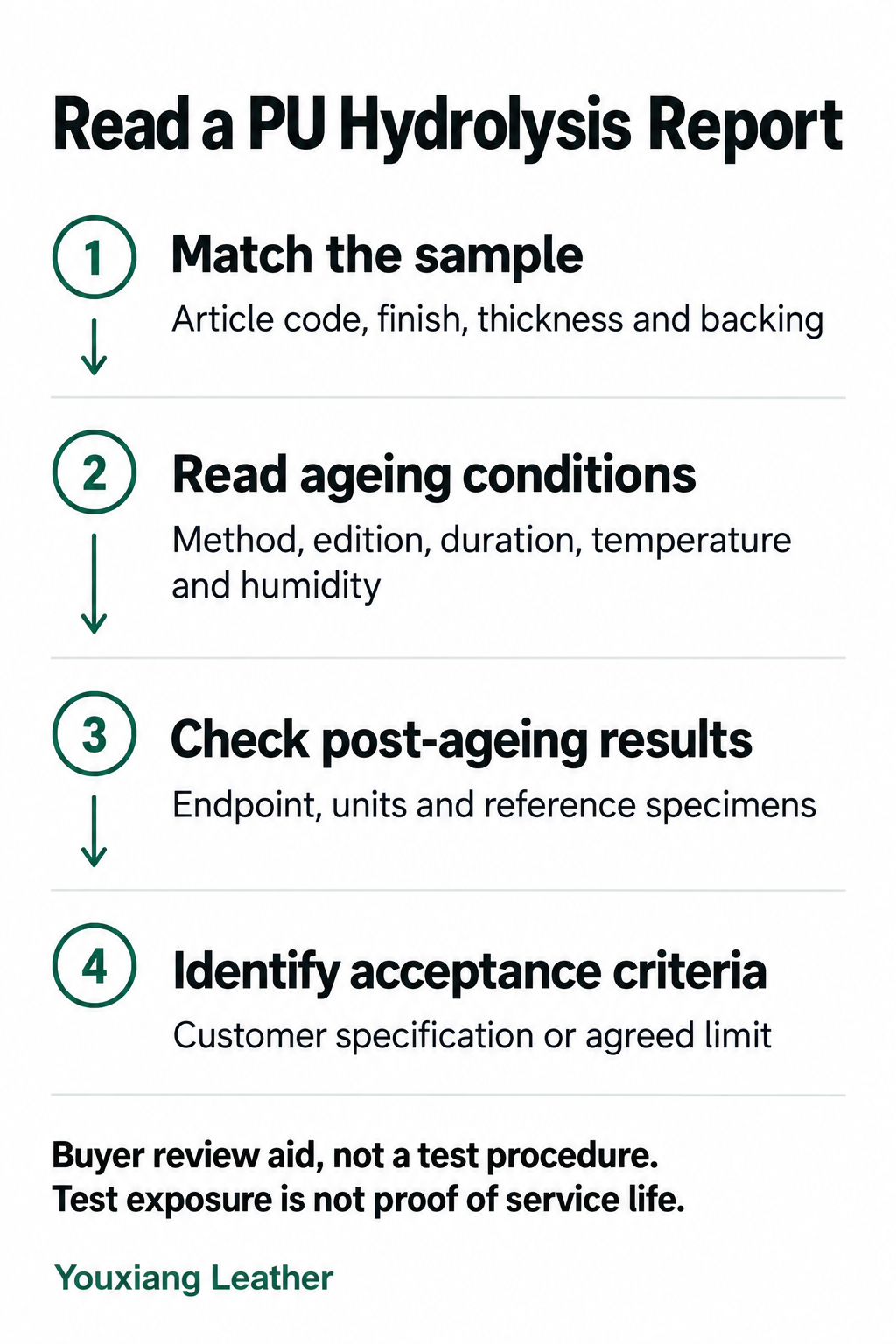
A PU hydrolysis test report is useful when you can connect its result to the material you intend to buy and the requirement your shoe must meet. Before approving a coated upper material, check four things: which sample was tested, how it was aged, what was evaluated afterwards, and which acceptance criteria were applied.
A statement such as “hydrolysis passed” leaves those questions open. Ask for the complete report and any referenced specification before using that statement in a purchasing decision.
Keep test exposure separate from service life
The Association for Contract Textiles (ACT) cautions against converting weeks of hydrolysis testing directly into years of use. Its guidance concerns polyurethane-coated upholstery, and its recommended minimum is for general indoor contract upholstery. That recommendation should not be adopted as a footwear acceptance limit.
Source: ACT hydrolysis guidance — https://contracttextiles.org/learn/hydrolysis-what-you-need-to-know/
When a supplier describes a material as having “several years of hydrolysis resistance,” ask what the number represents: a test exposure, a separately supported service-life estimate, or a written warranty. Keep those claims separate in your approval record. An exposure period alone does not establish a warranty.
For footwear development, agree the relevant method and requirements with the customer and laboratory. Record the exposure duration in the report’s original time unit, alongside the ageing conditions and post-ageing results, rather than converting days or weeks into years.
Find out what was checked after ageing
SATRA TM344 provides a footwear-specific example. Its public summary describes warm, humid ageing followed by tests on treated specimens and untreated references. For PU upper materials, listed examples include flex-cracking resistance, coating adhesion and colour fastness to rubbing. The public summary does not provide a complete laboratory procedure or a universal pass limit.
Source: SATRA TM344 — https://www.satra.com/test_methods/detail.php?id=255
This distinction matters when comparing quotations. One report may document appearance after exposure; another may report a measured property afterwards. Do not rank the materials by exposure duration until you have checked whether the reports answer the same question.
If your concern is the coating separating from its backing, identify the adhesion or delamination test used. SATRA TM410 addresses adhesion between a discrete coating and its textile base, while ISO 17698 covers delamination resistance of coated footwear uppers. These scopes help identify the property being assessed; they do not make the methods interchangeable or establish your buying limit.
Sources: SATRA TM410 — https://www.satra.com/test_methods/detail.php?id=294
ISO 17698 — https://www.iso.org/standard/60980.html
Use this report review checklist
The following is a buyer’s review aid, not a replacement for a test method or laboratory advice.
- Match the sample to the purchase. Look for the article code, colour or finish, thickness, backing description and sample identification. Ask how the tested material relates to the proposed order or batch. A broad name such as “microfiber PU” is insufficient traceability.
- Identify the method and edition. Record the ageing method, its version, any deviations, and each subsequent test method. A report headed only “jungle test” needs clarification.
- Read the exposure details. Find the duration, temperature, humidity and any interruptions or staged assessments stated in the report. If important details are absent, ask the laboratory for clarification rather than supplying conditions from another method.
- Identify the endpoint. Was the result a visual assessment, flexing performance, coating adhesion, rubbing fastness or another property? Record what was actually measured and how the result was expressed.
- Check the comparison. Where reference specimens are part of the test, review their results alongside the aged specimens. Retain units, specimen direction, and any stated conditioning or drying between ageing and testing. Ask about missing reference data or preparation details that prevent a like-for-like comparison.
- Locate the acceptance rule. Ask which customer specification, agreed limit or grading rule supports “pass.” A result without a stated criterion may still be useful data, but you need the relevant requirement to make an approval decision.
- Keep the evidence together. Retain the complete report number and date, laboratory identity, specimen photographs where available, observations and any stated qualifications. Resolve a mismatch with the supplier or laboratory before relying on the report.
When the material peels or cracks
Start by recording the visible damage and its location. Hydrolysis is a chemical degradation mechanism; peeling is an observation. ACT notes that some chemical exposures can produce damage resembling hydrolysis in coated upholstery. That supports caution about appearance-only diagnosis, rather than identifying the cause of a footwear failure.
Source: ACT hydrolysis guidance — https://contracttextiles.org/learn/hydrolysis-what-you-need-to-know/
For an upper sample, work through the issue in this order:
- Observe: Photograph the face, backing and exposed edge, and mark where the damage began. Keep an unused reference if one is available.
- Consider possible causes: Ask whether the coating itself is damaged, the coating has separated from its backing, or a bond introduced during lamination or shoe assembly has separated. Do not label every separation “PU hydrolysis.”
- Check: Give the laboratory the exposure history, processing details and failed sample. Ask it to identify the failed layer or interface and recommend the relevant investigation. Coating adhesion evidence should not be treated as proof that a separate assembly bond is satisfactory.
- Validate: Evaluate the selected replacement in the intended component, using the agreed ageing and follow-on checks. Record both the observed failure mode and the result before deciding whether the change resolves the concern.
Make a decision the evidence can support
Consider two hypothetical report summaries. The first states only that appearance was acceptable after an exposure period. The second identifies an aged coating-adhesion result, a reference result and an agreed acceptance limit. The first leaves adhesion unanswered; the second provides evidence about adhesion under its stated conditions. Neither summary, by itself, establishes the service life of a finished shoe.
Use the report to close a specific approval question. If your concern is post-ageing adhesion and that result is missing, request the missing evidence instead of treating a general pass statement as approval. If reports use different conditions or endpoints, ask the laboratory whether a meaningful comparison is possible or whether comparable testing is needed.
Keep the final decision tied to the selected material and the intended shoe construction. A trial component can address assembly questions that a roll-material report does not cover. Document unresolved items before issuing production approval.
For construction terminology, see microfiber PU and imitation microfiber-backed PU:
https://youxiangleather.com/guides/microfiber-pu-vs-imitation-microfiber-pu/
When preparing the inquiry, use the footwear material sourcing checklist to keep the material reference, intended component and testing requirements together:
https://youxiangleather.com/guides/footwear-material-sourcing-checklist/
Have a material reference to match?
Send the shoe component, clear face, backing and edge photos, your color reference and estimated quantity.
Related guides
PU Shoe Uppers Tearing Along Stitch Lines
Check PU upper seam failures by separating thread breakage, material tear and yarn slippage, then plan comparable sewing trials and suitable testing.
Read guide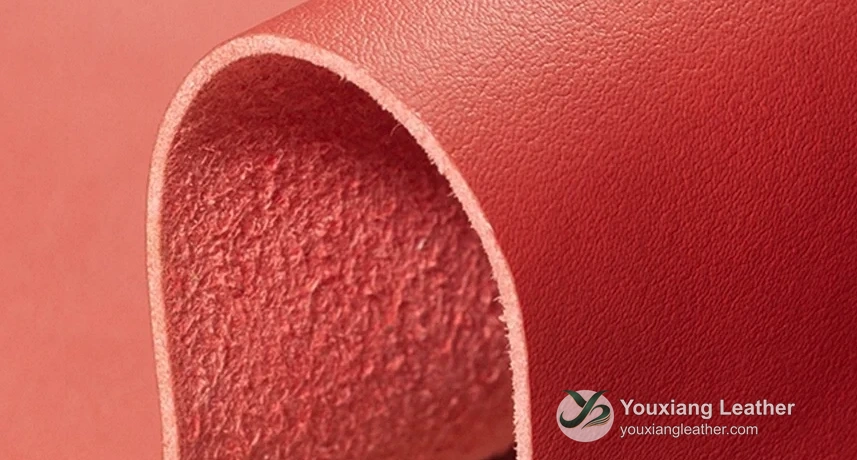
How to Choose PU Leather for Shoe Uppers
Compare shoe components, backing, thickness and physical samples before choosing PU upper materials. Use this practical footwear sourcing checklist.
Read guide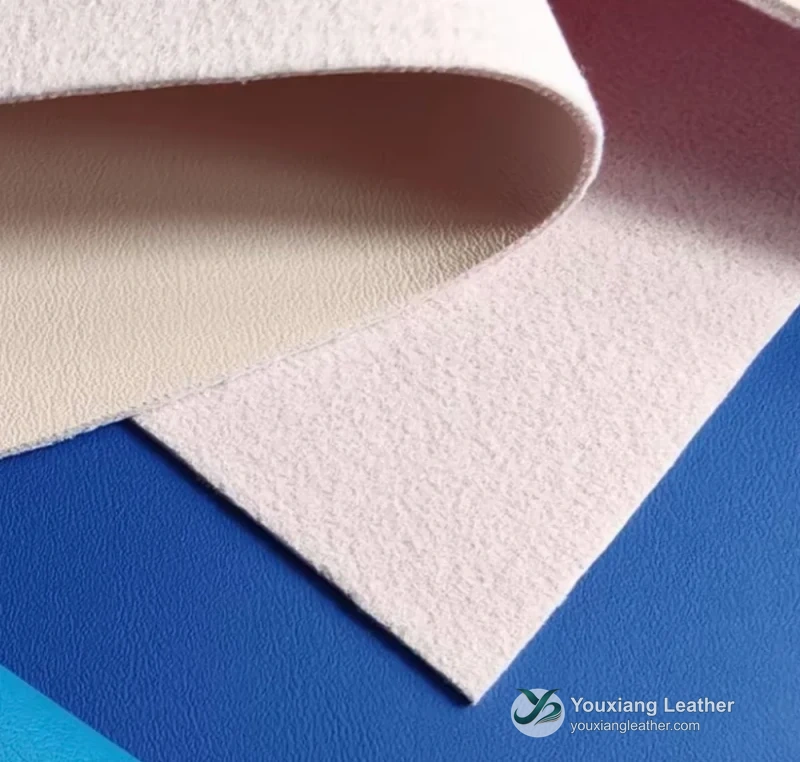
Microfiber PU vs Imitation Microfiber PU
Compare microfiber PU and imitation microfiber-backed PU using real sample photos, construction questions and a practical quotation checklist.
Read guide